Player Prop Analyzer: Best Free and Paid Tools for Prop Research
How prop research tools actually work, how to read their output without fooling yourself, and what they cost at every tier from free plans to premium.
By
Eric Pauly
9 min read
What Is a Player Prop Analyzer?
A player prop analyzer is software that pulls a player’s game logs, situational splits, hit rates against the posted line, projections, and live prices from multiple sportsbooks into a single screen. That is the entire job. It compresses research, and it does not pick for you.
The reason it matters more now than it did five years ago is volume. One NBA slate can carry over a thousand prop lines across points, rebounds, assists, threes, and combos, and most of them go up a few hours before tip. Nobody hand checks a thousand numbers. The bettors finding the soft ones are the ones whose research runs in seconds instead of minutes, which is why player prop research tools have gone from nice to have to standard equipment.
Below: what these tools actually assemble, how to read the output without talking yourself into a bad number, how to run a routine on a full slate, what the options cost, and where the whole approach breaks down.
article Summary
A player prop analyzer consolidates game logs, splits, hit rates, projections, and live prices from multiple books into one screen so you can judge a prop in seconds instead of tabbing between five sites. Props.Cash and PropsMadness are the prop-first options at roughly $20 a month, Pine Sports covers the basics at $9.99, and several tools now run permanent free tiers. The software speeds up the research. Deciding what the number should be is still on you.
Breaking Down a Player Prop Analyzer
Props are not priced the way sides and totals are. A Chiefs moneyline sits on the board for days and absorbs enough sharp money that it lands close to fair by kickoff. A third receiver’s reception line goes up a few hours before the game, with a low limit and a fraction of that attention behind it. The distance between those two markets is where prop research earns its keep, and it is why a dedicated prop tool is worth more here than it would be on a spread.
What a Player Prop Analyzer Actually Pulls Together
Strip the branding off and every prop analyzer is doing the same five jobs:
Game logs you can filter by opponent, home or away, rest, and who else is in the lineup
Hit rate against the current line across several sample windows, not just the last ten
Team pace, opponent rank against the position, and usage or target share
A projection for the stat, so you have your own number to set against the posted one
Live prices for that prop across the books you actually have accounts at
Every one of those exists for free somewhere. Baseball Reference has the logs, a team stats page has the pace, your sportsbook app has the price. Assembling all five for one prop takes a few minutes. Assembling them for forty props on a Tuesday NBA slate takes an evening, and that wall is the reason paid research software exists at all.
Why Prop Bet Research Matters More Than Ever
Books post more props every season and they have gotten sharper on the headline names. Aaron Judge total bases and Ja’Marr Chase receiving yards take real money and land close to fair. What has not changed is the tail. The deeper into a slate you go, into backup bigs, second tight ends, and reliever strikeout lines, the thinner the market behind the number gets. A repeatable research process helps you:
Spot lines that moved because of one loud game rather than a real change in role
Fade numbers inflated by recency bias and whatever narrative is loudest that week
Separate stats that predict future performance from stats that only describe the past
Example
Example
Two props in the same Yankees game are not the same research job. Aaron Judge total bases is a heavily bet market with real limits, so the posted number has already been beaten into shape. The seventh inning reliever’s strikeout line in that same game gets a small fraction of that action. When you are deciding where to spend twenty minutes of research, start where the money is not.
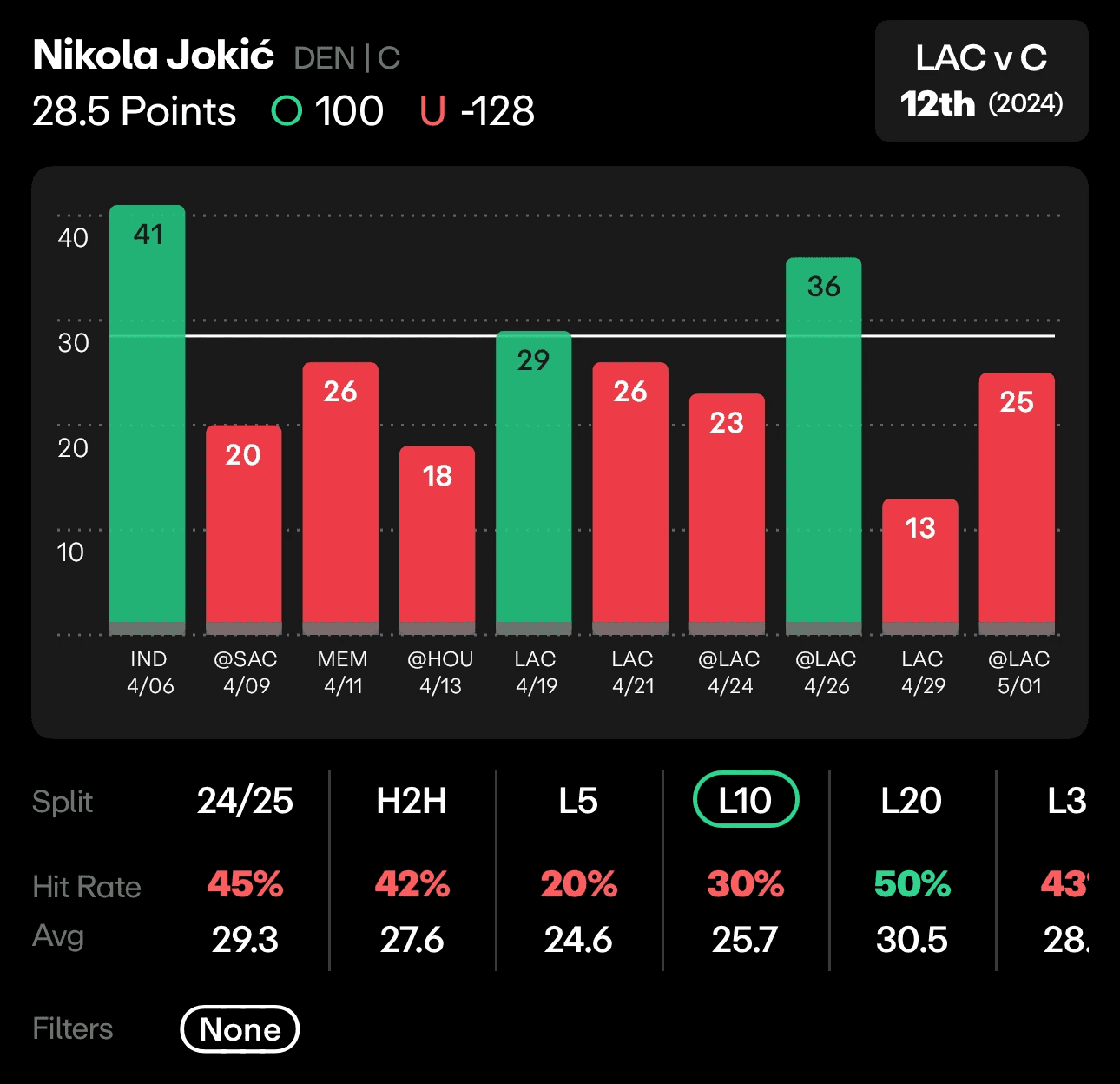
How to Analyze Prop Bets Like a Pro
The stats that matter are the ones that describe a player’s role, not a player’s reputation. Books know the reputation. Role changes are where the pricing lags, and pairing a log screen with a projection is how you catch the lag before it corrects.
Key Stats to Track for Player Props
Points, rebounds, receptions, or strikeouts, the inputs are largely the same:
Game logs filtered to conditions that resemble tonight, rather than a raw last ten
Opponent rank against the position, which moves a tight end line far more than a workhorse back’s rushing line
Minutes, usage rate, and target share, the inputs that drive every counting stat downstream
Hit rate against the current line over 10 game, 20 game, and season long windows
Pace, since a few extra possessions per game quietly lifts every points and rebounds number on the board
None of these are predictive on their own. Together they give you a defensible estimate, and that estimate is the point. Once you have it, the posted line is either above your number, below it, or close enough to skip.
Trends, Matchups, and Usage Rates
Usage is the input most bettors underweight. A guard averaging seven assists on the season is a completely different bet depending on whether the primary ball handler next to him is playing. Same for a wide receiver whose target share spiked over three games because the tight end was out. The season average does not know that. The filtered split does.
When I have a prop tool open next to a sportsbook app, the first split I check is not the last ten games. It is the same player’s logs with tonight’s actual starting five or actual depth chart, because that is the only sample that describes the bet in front of me.
Common Mistakes in Prop Analysis
Most losing prop research fails in the same handful of ways:
Reading a hit rate without checking what the line was in those games
Leaning on season averages when the role changed a month ago
Ignoring the price, because 60% at -145 and 60% at +100 are not the same bet
Skipping pace, blowout risk, and late scratch news
Betting the first price you see instead of the best one on the board
Our breakdown of player prop hit rate goes deeper on the first one, which is the mistake that costs the most.
Using Props.Cash as Your Player Prop Analyzer
Plenty of tools list prop data. Fewer are built so the filtering is fast enough to use while lines are still moving. That is the bar that matters, and it is where Props.Cash earns its $19.99 a month.
Props.Cash is Built for Prop Betting Research
Props.Cash was designed around one question: what has this player done in situations that look like tonight? The filter set answers it directly. If you want to know how an NBA guard performs on the second night of a back to back, you filter to back to backs and read the number. You are not exporting a CSV or building a pivot table.
Core Features That Help You Analyze Smarter
The features that carry the most weight in a live research session:
Game logs sortable by opponent, home or away, rest, pace, and teammate availability
Line movement tracking, so you can see where a prop opened and where it is drifting
Visual trend charts that make a role change obvious at a glance
Historical hit rates measured against the actual line, not a static threshold
Prop projections and line shopping so the research and the price live in the same place
The honest tradeoff is scope. Props.Cash does props and only props. There are no game lines, no arbitrage screen, and no +EV feed, so if you want one subscription covering everything, our Outlier vs Props.Cash comparison lays out which side of that tradeoff fits you. For a prop-only bettor, the narrow scope is the feature.
Props.Cash runs a 7-day free trial, and code BETSMART takes 30% off your first month.
Example
Example
Say you are looking at Jalen Brunson over 6.5 assists. Inside Props.Cash, the sequence runs:
Pull his assist logs and filter to opponents in a similar defensive tier and a similar pace band
Read the hit rate against 6.5 over the last 10, last 20, and season long samples
Split the logs by which teammates are on the floor, since a second creator changes the assist math
Check whether the line opened at 5.5 and climbed, which tells you the market already moved
Compare the over price across your books before you send it
That is a full read on one prop in about ninety seconds, which is the only reason it scales to a fifteen game slate.
Building a Prop Research Routine You Can Run on a Full Slate
Owning an analyzer and having a process are different things. The bettors who get value out of these tools are the ones who run the same sequence every night instead of browsing until something looks appealing.
Start With the Board, Not the Player
Opening a tool and typing in a favorite player is how you end up justifying a bet you already wanted. Start from the market instead. Sort the board for lines that moved most since open, or for props where your tool’s projection sits furthest from the posted number, then work down that list. You are letting the disagreement pick your research targets.
The pattern worth watching for: a line that has not moved on a player whose role clearly changed this week. Markets update fast on injuries to stars and slowly on the third option who just absorbed those touches.
Match the Tool to the Sport
Prop tools are not equally good across sports, and the gap is widest in baseball, where park and weather swing outcomes more than anywhere else. PropsMadness leans into that with pitch level matchup grading, park and weather data through a Ballpark Pal partnership, closing lines plotted on every prop chart, and odds from 40+ sportsbooks. It runs $20 a month, rising to $25 a month on September 1, 2026, and code BETSMART takes 25% off your first purchase. For NBA and NFL research, Props.Cash and PropFinder cover the ground more thoroughly. Football bettors can start with our NFL player prop tool guide.
Finish on Price
Research tells you which side you want. It does not tell you what to pay. Prop lines vary between books more than sides do, since fewer books price them independently, and a couple of cents on a market you bet weekly compounds across a season. Whatever tool you use, the last step is comparing the number across every account you hold.
Free and Cheap Player Prop Analyzer Options
Not every bettor needs a $50 a month research stack. If you want a player prop analyzer that is free or close to it, here is what is worth considering at each price point.
Free Tiers and Free Trials
The free tier has quietly become the standard entry point in this category, and most of them cap you by games rather than by features. PropFinder and Doink Sports both run permanent free plans covering one game per league. Pine Sports is free with usage limits, so you can run its AI chat and open the prop sheets before any card is charged. Linemate keeps a permanent free tier covering single-trend analysis and basic props. PropsMadness lets you research a limited number of players per day with no account and no card.
On the trial side, Outlier opens every tool during a 7-day trial rather than limiting you to the cheapest tier, Props.Cash runs a 7-day trial, and Linemate gives new users 7 days of Linemate+. A week is enough to answer the only question that matters: does the tool change what you bet, or does it just make you feel more prepared?
Under $15/Month
Pine Sports Starter at $9.99 a month is the cheapest paid prop tool worth using, and it bundles an AI chatbot, confidence grades, and a +EV finder on top of prop research. PropFinder at $14.99 grades every prop with a proprietary rating out of 100, which is useful for narrowing a big board fast, and code BETSMART takes 30% off your first month. Linemate+ also sits at $14.99 a month, or $59.99 a year, which works out to about $5 a month, and it is trend and parlay first rather than a deep filtering tool.
$15 to $25/Month
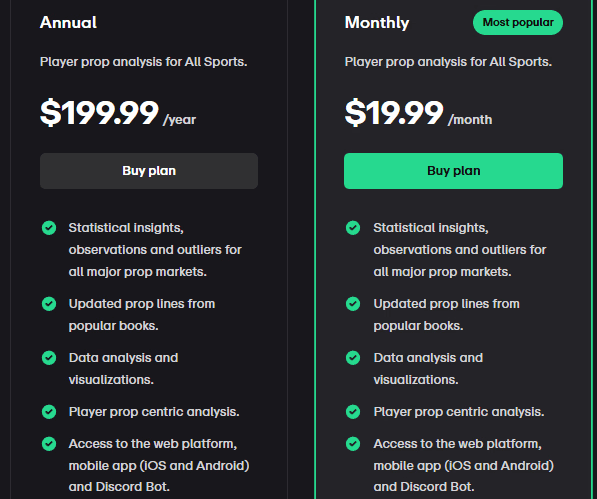
This is where the prop specialists live. Props.Cash at $19.99 has the deepest filter set for NBA and NFL. PropsMadness at $20, moving to $25 on September 1, 2026, is the stronger baseball build. Doink Sports Starter runs $19.99 with line shopping and cheat sheets, stepping up to $32.99 for Pro. Outlier starts at $19.99 and trades some prop depth for game lines, arbitrage, and +EV coverage, with the full Pro feature set at $79.99.
When Free Is Not Enough
Free prop research is real, it is just narrow. A one game per league cap is fine for a single primetime matchup and useless on a twelve game Saturday, and manual stat lookups miss the cross-book comparison that decides whether a bet is worth taking. Working by hand, a serious pre-slate session runs closer to twenty minutes per game than five, and the number of props you can realistically evaluate collapses. If you bet props more than occasionally, the $10 tier pays for itself on volume alone. Our guide to free player prop tools covers every no-cost option in detail, and our best player prop tools guide explains what to prioritize when you do start paying.
Final Thoughts
A player prop analyzer is a speed tool. It takes research that used to eat an evening and compresses it into the window between lines posting and first pitch or tip-off, which is the only window where soft numbers reliably exist. That is a real edge, and most of the category sits under $20 a month.
What it will not do is replace judgment. The tool shows you a 65% hit rate. Deciding whether that rate survives tonight’s lineup, tonight’s pace, and tonight’s price is still your call. Treat the output as the start of the work and these tools earn their keep. Treat it as a pick and you find out how expensive a well filtered split can be.
Use code BETSMART for 30% off your first month of Props.Cash.
Player Prop Analyzer FAQ

Additional Resources
Explore our curated selection of guides and tools to help promote responsible gambling.

College Basketball Betting: How to Bet NCAAB From Tip Off to March
How to bet college basketball spreads and totals, from soft November lines through conference play, with tempo math and line shopping tips.

Lacrosse Betting Guide: How to Bet NCAA, PLL, and NLL Games
How lacrosse betting works across NCAA, PLL, and NLL games, from faceoffs and shot clocks to line shopping in thin markets.

Horse Racing Betting: A Guide to Pools, Odds, and Value
How horse racing betting actually works, from parimutuel pools and takeout to past performances, overlays, and where to bet.

Snooker Betting Guide: Race Length, Markets, and Live Angles
How snooker odds work, which markets to use, and how race length, schedules, and session breaks change what a fair price looks like.