Best Prop Bets: How to Spot Value and Bet Smarter
Learn how to spot the best prop bets by price, not hype, using no-vig math, smarter research, and tools built for player props.
By
Eric Pauly
9 min read
What are the Best Prop Bets?
Every NFL Sunday, "best prop bets" posts flood social media with the same names: Josh Allen over passing touchdowns, Ja'Marr Chase over receiving yards, Aaron Judge to homer. Some of those are fine bets, but the player is not what makes them good. The best prop bets are the ones where the sportsbook's price implies a lower chance than the real one, and that gap lives in the number, not the name.
My first filter on any slate is price, not player. I pull up the two-way market, strip out the vig, and only then open the game logs. This guide walks through that price-first approach: how to read what a prop line asks of you, where soft numbers tend to show up on NFL, MLB, and NBA boards, how player prop research tools like Props.Cash and Prop Professor fit in, and how to tell whether your props are actually good after they settle.
article Summary
The best prop bets are defined by price, not star power: a prop is worth betting when your estimated probability beats the implied probability after the vig is removed. Look for value in thin spots like news windows, secondary stat markets, alt lines, and books that disagree, use research and pricing tools to move faster, and judge your process by closing line value instead of one night's results.
What Makes a Prop Bet “Good”?
A prop bet is good when the price is wrong in your favor. That is the whole definition. A Ja'Marr Chase over 74.5 receiving yards at -150 can be a poor bet while the same over at +100 somewhere else is a strong one, even though the player, the matchup, and your read have not changed. Popular overs on stars tend to carry that public demand in the price, which is why value often sits on unders, role players, and less glamorous stat categories.
It’s Not About Hype, It’s About Value
Every prop price converts to an implied probability, the hit rate you need just to break even. Your job is to estimate the true probability and compare the two. If your research says an over lands 55% of the time and the book charges -110 (52.4%), you have a small edge. If the book charges -130 (56.5%), you do not, no matter how confident the take feels.
Keep this quick reference handy when you scan a board:
-150 implies 60.0%
-130 implies 56.5%
-120 implies 54.5%
-110 implies 52.4%
+100 implies 50.0%
+120 implies 45.5%
+150 implies 40.0%
Key Metrics to Look At Before Placing a Prop Bet
Once the price tells you what hit rate you need, research tells you whether the player can clear it. These inputs move props the most:
Role and volume: snaps, routes, and targets in the NFL; minutes and usage in the NBA; lineup spot and plate appearances in MLB
Median, not just average: one 150-yard game can drag a receiver's average well above what he produces in a typical week
Hit rate at this exact line: a player prop hit rate of 70% at 64.5 yards says little about a line of 74.5
Game environment: spread, total, pace, and blowout risk, which decide how long starters stay on the field
Price across books: the same prop can be a few cents or twenty cents apart depending on where you look
Example
Example
Say one book lists Saquon Barkley rushing yards at 84.5, with the over at -115 and the under at -105. Those prices imply 53.5% and 51.2%, which adds up to 104.7%. The extra 4.7% is the vig. Divide each side by that total and the no-vig estimate lands around 51.1% for the over and 48.9% for the under.
Now a second book hangs the same under at +110, which only requires 47.6% to break even. Against that 48.9% fair estimate, the under at +110 carries roughly a 2.7% edge before you look at a single game log. One book's market is a rough baseline, and a consensus of several books makes a better one. You can run these numbers in seconds with the no-vig odds calculator. Treat the numbers here as the method, not a pick.
How to Find the Best Prop Bets Each Day
Sportsbooks post thousands of props across a full NFL Sunday or MLB slate, and they cannot price all of them with the care they give a spread. That gives you a place to start. Instead of opening with players you like, open with the parts of the board where pricing tends to be thinnest.
Where Soft Prop Lines Tend to Show Up
When I scan a Sunday NFL prop board across several books, receiving yards lines on the same player often sit a yard or two apart, with the juice swinging 15 to 20 cents on top of that. Those gaps are not random. They cluster in a few predictable spots:
News windows: NFL inactives drop about 90 minutes before kickoff, and NBA injury reports update through the afternoon. When a starter sits, books pull and repost teammate props, and the new number does not always fully reflect the new workload.
Secondary stat categories: rushing attempts, receptions, pitcher outs recorded, and batter total bases draw less action than passing yards or home runs, so books get less market feedback on them.
Books that disagree: when FanDuel, DraftKings, BetMGM, and Caesars post the same prop at different numbers, the outlier deserves a look.
Alternate lines: alt ladders are often priced off a formula from the main line, which can leave individual rungs off the fair curve.
Pick'em apps: fixed lines on PrizePicks and Underdog can lag sportsbook moves, which is covered in more detail below.
Avoiding Traps: What Looks Good but Isn’t
A prop can look soft for reasons that disappear once you check the context:
Outlier games inflating a hit rate or average, like a big stat line in an overtime game
Role changes the sample has not caught up to yet, such as a starter returning from injury and taking back the targets or minutes a backup was feeding on
Opponent rankings built on raw totals, since a defense that allows the most receiving yards may simply face the most pass attempts because it plays with leads
Park and weather context in MLB, where a total bases line at Coors Field is priced differently from one at Oracle Park for good reason
News you got last, because if a strikeout line already moved from 5.5 to 6.5, the market likely knows what you just read
Building a Repeatable Prop Bet Process
The version of this that holds up across a season is consistent more than clever. A simple daily routine looks like this:
Scan the board for price gaps between books and markets that moved on news
Devig the market to get a fair probability for the props that stand out
Research role, matchup, and game environment to confirm or kill each idea
Shop the final number across every book you have access to
Log the bet with the line you got and the closing line
Using Props.Cash to Find the Best Prop Bets
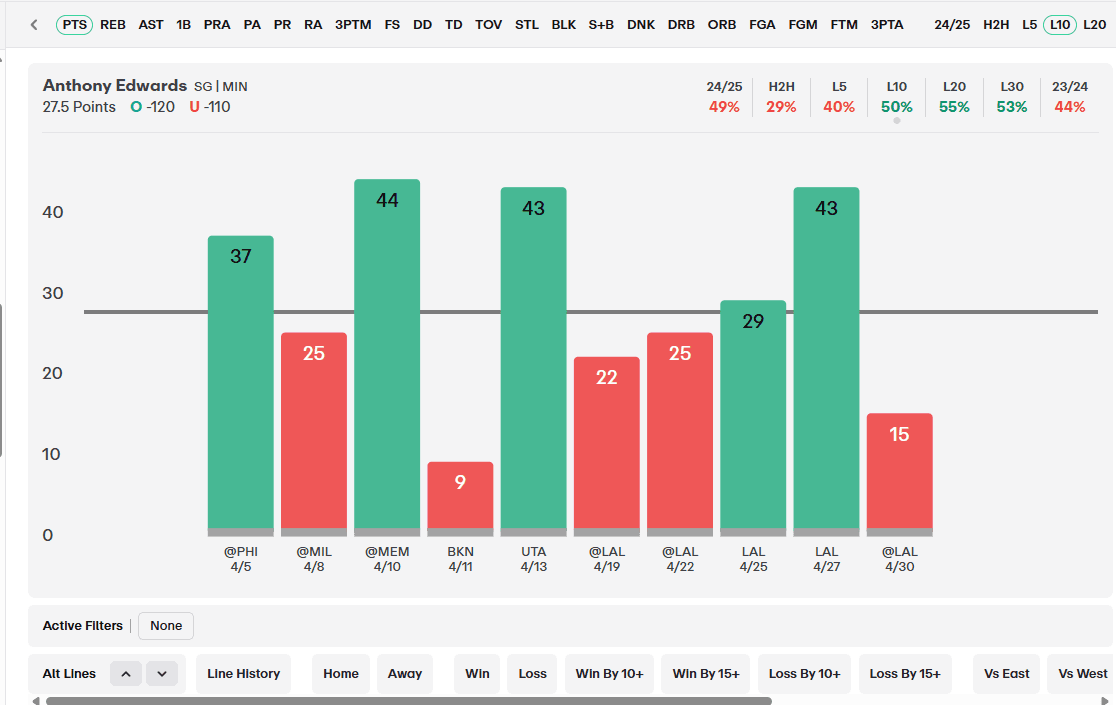
Research is where most prop bettors lose time, and it is where Props.Cash earns its spot. It pulls hit rates, game logs, splits, and matchup context for the NFL, NBA, MLB, NHL, WNBA, and college sports into one screen, so you can get from a full prop board to a shortlist without juggling five tabs. For a deeper look at features and limits, read our Props.Cash review.
Custom Filters, Game Logs, and Hit Rates
When testing Props.Cash, the filters were what separated it from a basic stats site. You can:
View hit rates against the current line over the last 5, 10, or 20 games, or the full season
Split results by home or road, rest days, head-to-head, and divisional opponents
Filter to games where a specific teammate was out, which is how you check a usage bump after an injury
Sort the trends list by matchup grade so the softest spots rise to the top
Props.Cash costs $19.99 per month or $199.99 per year, and the 7-day free trial does not require a card. Use code BETSMART on the web checkout for 30% off your first month of Props.Cash.
Where Props.Cash Stops and Prop Professor Picks Up
Props.Cash is a research tool, not a pricing tool. It shows odds from multiple books, but those lines are not real-time and you cannot click through to place a bet, so a number on screen can be gone by the time you reach the sportsbook.
Prop Professor works from the price side. Its +EV screen lets you choose which sportsbooks feed your fair value, set custom devig methods and per-book weights, and watch pregame odds refresh roughly every two seconds. It also runs DFS optimizers for base and alt lines on pick'em apps. The All Access plan is $49 per month, and code BETSMART takes 25% off your first month of Prop Professor. Our Prop Professor review covers the settings in more detail.
The pairing works because the two tools answer different questions. Props.Cash helps you judge whether the player can clear the line, and Prop Professor helps you judge whether the price is worth paying.
Example
Example
Say Tee Higgins is ruled out on Friday and you want to know what that means for Ja'Marr Chase's receiving yards on Sunday. In Props.Cash, the workflow looks like this:
Open Chase's receiving yards prop and check his hit rate at the current line over the last 10 and 20 games
Apply the teammate filter to show only games Higgins missed, then compare target volume and yardage to the full sample
Check the head-to-head split against this week's opponent, keeping the small sample in mind
Note the line, then check Prop Professor or your sportsbooks to see whether the number already moved on the Higgins news
If the filtered sample shows a real bump and at least one book still hangs the pre-news number, you have a bet worth considering. If every book has already moved, the research still paid off: you learned the market got there first.

Pick'em Apps vs Sportsbooks: The Break-Even Math on Prop Bets
PrizePicks, Underdog, and other pick'em apps have become a big part of how people bet props, and they change what a good prop looks like. Instead of a price on each side, you get a fixed line and a fixed payout for the whole entry. The break-even math lives in the payout table, not in the individual pick.
What a Fixed Payout Asks of Each Leg
To break even, each leg has to hit often enough that the combined probability matches the payout. Assuming independent legs, here is what these illustrative multipliers require per leg (payout tables vary by app, state, and entry type, so check the current one):
2 picks paying 3x: about 57.7% per leg, roughly a -137 sportsbook price
3 picks paying 5x: about 58.5% per leg, roughly -141
4 picks paying 10x: about 56.2% per leg, roughly -128
Compare that to the 52.4% you need on a standard -110 sportsbook prop and the gap is large. A pick'em leg that is a true coin flip loses money over time, even when the lineup screen makes it feel free.
When Pick'em Lines Are Worth Playing
Pick'em apps tend to move their lines more slowly than sportsbooks. If books shift Josh Allen's passing yards from 244.5 to 254.5 and an app still shows 244.5, the over on the app may be priced well past its break-even threshold. That lag is the edge, and it is what Prop Professor's DFS optimizers are built to surface by comparing app lines against devigged sportsbook prices. Apps that change the multiplier on alternate lines are another spot worth running through that kind of screen, since the multiplier is the price.
How to Tell If Your Prop Bets Are Actually Good
A single night of props tells you almost nothing. A 3-for-5 night can come from bad bets that got lucky, and an 0-for-4 night can come from sharp ones that ran into variance. The more reliable signal is whether you consistently beat the closing number.
If you bet an over at 5.5 strikeouts and the market closes at 6.5, you got a better number than the market settled on, whether the bet cashes or not. Log every prop with the line and price you took, then record the closing line and price. Prop markets are thinner than sides and totals, so a consensus close across a few books is more trustworthy than one book's final number. Across a few hundred bets, closing line value tells you far more about your process than your win rate does.
Final Thoughts
The best prop bets are prices, not players. Start with the number, strip out the vig, and look in the corners of the board where books pay the least attention: news windows, secondary stats, alt lines, and pick'em apps that lag the market.
Use Props.Cash to check whether the player can clear the line and Prop Professor to check whether the price is worth it, then shop every book you have. Track your closing line value, and let a few hundred bets tell you whether the process is working.
Best Prop Bets FAQ

Additional Resources
Explore our curated selection of guides and tools to help promote responsible gambling.

Where to Trade Sports Without Getting Limited
Where limited traders take their volume: ProphetX, Novig, and what replaces sportsbook account caps.

Prop Builder Tools: Apps That Build and Price Your Prop Slips
Prop builder tools that build, price, and send your parlays and pick'em slips, sorted by what each one actually does.

How to Avoid Getting Limited by Sportsbooks: A Practical Playbook
You cannot hide a real edge forever, but you can slow sportsbook limits down and have a plan for when they arrive.

Sports Betting Database: Historical Odds, Results, and Trends
Historical odds, results, and trend databases explained, with an honest look at what betting trends can and cannot tell you.