Live Arbitrage Betting: How to Profit During the Game
Live arbitrage betting turns in-game pricing gaps into locked profit, and the whole thing comes down to how fast you get both legs down.
By
Eric Pauly
9 min read
Live Arbitrage Betting Is an Execution Problem
Live arbitrage betting is not hard to understand. Two sportsbooks price the same in-game market differently, you take both sides, and the math pays you whichever way the game breaks. The hard part is that the gap is usually open for 20 or 30 seconds. A pre-game arb sits on the board while you think it over. A live arb does not.
So this guide treats live arbing the way it actually plays out: a timing and execution problem first, a math problem second. You get the triggers that open a window, the stake math on a live example, a placement sequence that keeps you from getting stuck holding one naked leg, and the arbitrage betting tools fast enough to surface these gaps while they still exist.
article Summary
Live arbitrage betting means taking both sides of an in-game market at two sportsbooks whose prices have drifted far enough apart that either result pays. Margins usually run 1% to 3%, the windows close in under a minute, and the profit comes from execution speed rather than handicapping. A live scanner such as Bookie Beats paired with a real-time odds screen is the practical setup.
What Is Live Arbitrage Betting?
Live arbitrage betting, also called in-game arbing, means taking both sides of the same market at two sportsbooks while the game is running, at prices far enough apart that the two bets combined return more than they cost. Whichever way the result lands, one leg covers the other and the difference is yours.
The math is identical to pre-game arbitrage. The conditions are not. In-game prices come from models reacting to a live data feed, and those models do not all react at the same speed. Disagreement between books shows up in short bursts instead of sitting on the board for an hour, which is why live arbing gets judged on execution rather than on finding the bet.
The Two Number Check
Every live arb reduces to one calculation. Convert both prices to implied probability, add them together, and look at the total. Anything under 100% is an arb, and the distance below 100% is close to your margin. Worth memorizing the common conversions so you can eyeball a screen instead of reaching for a calculator:
-250 is about 71.4% implied
-150 is 60% implied
-110 is about 52.4% implied
+100 is 50% implied
+130 is about 43.5% implied
+180 is about 35.7% implied
Two live prices at +130 and -110 add up to roughly 95.9%, an arb worth about 4%. That size is rare and usually means one book is about to suspend the market. Most of what a scanner confirms in live markets lands between 1% and 3%.
Why Live Arbitrage Opportunities Exist
Books do not share a clock. Each one runs its own pricing model off its own feed, with its own tolerance for how far a number can drift before it reprices, and its own trader watching the biggest markets by hand. Stack those differences and gaps open constantly.
The recurring triggers:
A scoring play that one data feed registers a beat or two before another
Injury news that reaches a trading desk before it reaches every model
A pitching change or a substitution that resets a total
One book suspending a market while a competitor keeps taking action at a stale number
Heavy one-sided money forcing a book to move for liability reasons rather than for the true price
When I run live MLB games through a real-time odds screen, the same seventh inning moneyline can sit 10 to 15 cents apart across books for half a minute after a bullpen change, because one model has fully priced the new pitcher and another has not. Our breakdown of live odds comparison goes deeper on why those feeds diverge.
Example
Example
Yankees at Red Sox, top of the sixth, Boston has just tied it. One book reprices the Yankees to +122 while another still shows the Red Sox at -110. Implied probabilities are 45.0% and 52.4%, adding to 97.4%, so the market is arbable by about 2.6%.
Split $1,000 in proportion to those probabilities: $462 on the Yankees at +122 and $538 on the Red Sox at -110. Yankees win and you collect about $1,026. Red Sox win and you collect about $1,027. Either way you clear roughly $26 on $1,000 of turnover, which is what a healthy live arb actually looks like.
Pros of Live Arbitrage Betting
✅ Wider Pricing Gaps
Live models disagree more than pre-game ones because they are reacting in real time instead of converging on a number over several days. Pre-game two-way arbs are often shaved to fractions of a percent by the time a public screen sees them. Live gaps clear 2% far more often.
✅ Repeat Chances Inside One Game
A pre-game slate gives you one look per market. A single NFL game reprices its moneyline, spread, total, alternates, and player props after nearly every drive, so one game can produce several qualifying gaps across four quarters.
✅ No Waiting on Openers
You are not parked on a scanner at 9am waiting for a book to post a number. The market keeps generating fresh prices for as long as the game is on.
Risks of Live Arbitrage Betting
⚠️ Rejections and Price Changes
The most common failure is not a bad read, it is a half-placed arb. A book suspends the market while your bet slip is open, or accepts the wager at a worse number, and you are left holding one naked side of a live game.
⚠️ Account Limits
Arbitrage flags accounts, and live arbing flags them faster. Books watch in-game action closely because that is where their exposure is hardest to manage, so a pattern of sizable live bets at off-market prices tends to draw limits sooner than the same behavior pre-game.
⚠️ Tied-Up Bankroll and Execution Stress
Both legs go live at once at two different books, which means funded balances sitting in several places and no time to deliberate. This is not something you run casually with a game on in the background.
One thing I did not expect the first time I tested live scanners side by side: the alert speed is rarely the bottleneck. The bottleneck is the number of clicks between seeing the alert and having money down at both books.
Best Tools for Live Arbitrage Betting
Live arbing is a coverage and latency problem before it is a strategy problem. A scanner refreshing every few seconds across ten books will surface a fraction of the live arbs that a faster tool covering a wide book list does, and by the time a slow feed flags a gap the price is usually gone. That narrows the field quickly once you filter for live markets.
Bookie Beats: Built Around Live EV and Arbitrage
Bookie Beats is a browser-based tool whose core product is live and pre-game +EV alongside live and pre-game arbitrage, which is a different starting point from tools that bolted a live tab onto a pre-game screen. It compares more than 18 books and markets, including Pinnacle, Circa, FanDuel, DraftKings, and the exchanges Novig, ProphetX, Kalshi, and Polymarket, and it ships with low hold detection, stake calculators for sizing both legs, one-click bet placement, and a private Discord. Read our full Bookie Beats review for the detailed breakdown, or try Bookie Beats here with code BETSMART for $50 off your first month.
One detail matters more than the price tag if live arbing is why you are subscribing. The $100 Basic plan covers the pre-game side only. The live in-game feeds and in-game edge alerts sit on the $400 Premium plan, and every new account gets seven days of full Premium free, so you can pressure test the live feeds during a real slate before deciding which tier your volume justifies. The honest limitations: there is no browsable odds grid inside it, the one-click button routes you to the right game without always loading the exact wager into your slip, and the first week is mostly configuration.
OddsLogic: The Odds Screen Behind the Alert
A scanner tells you a gap exists. An odds screen tells you whether it is real or a book that simply forgot to move. OddsLogic runs $99 per month after a seven-day free trial and covers 50+ sportsbooks including market makers like Pinnacle and Circa, with line movement history, injury alerts, and alerts for sharp plays, positive EV, and arbitrage. Being able to pull up how a number moved over the previous ten minutes is what separates a genuine arb from a stale price you should leave alone. Our OddsLogic review covers the depth in detail. There is no public promo code, so the free trial is the entry point at OddsLogic. It does not carry player prop line history or show book limits and liquidity, so it complements a live scanner rather than replacing one.
What to Check Before You Pay
Does it scan live markets natively, or is live a filter on a pre-game product
How many books it actually covers live, which is usually fewer than the pre-game count advertised
Whether alerts reach your phone, not just a browser tab you might not be looking at
Whether stake sizing is built in, so you are not doing arithmetic while the window closes
How many clicks stand between the alert and a placed bet at each book
Testing these tools against each other, the advertised refresh rate matters less than that last point. Software does not win the bet for you here, it buys you seconds, and seconds are the entire product in live arbing.
Example
Example
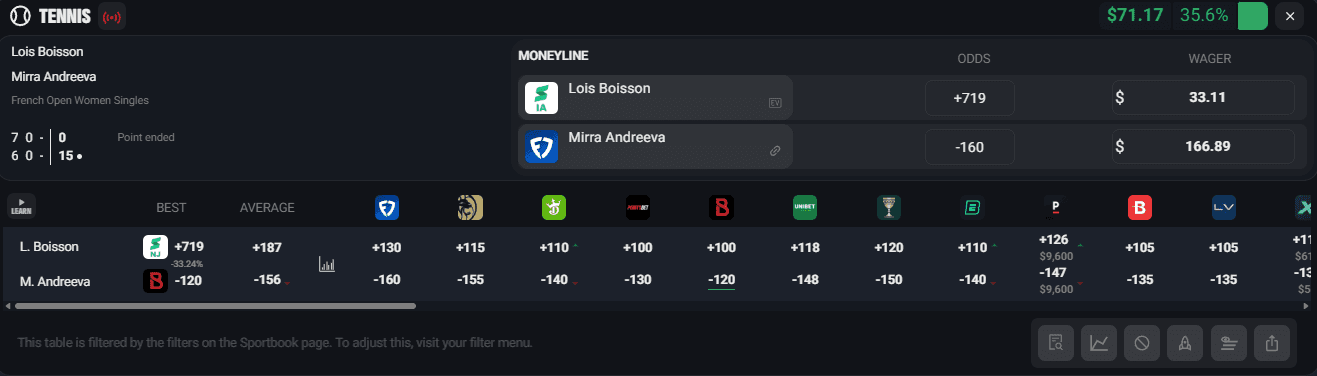
A confirmed live arb on a scanner shows four things: both books with both prices, the combined hold expressed as a negative number, the stake split for your chosen total, and how long the price has been available. That last one matters most. A gap that has been sitting for 40 seconds is usually a stale line at a book that will reject the bet or a market about to be suspended. A gap that appeared two seconds ago is the one worth clicking.

How to Place a Live Arb Before the Window Closes
Everything above is the easy part. Getting both legs down while the number still exists is where live arbing is won or lost, and a fixed sequence beats reacting every time.
The Placement Sequence
Have both books logged in, funded, and already open before the alert fires. Nothing kills a window like a login screen.
Confirm the gap on the scanner and check that the market is not already suspended at either book.
Place the harder leg first: the book with the lower limit, the slower app, or the price most likely to move.
Take the second leg immediately at whatever it is now, not at what the scanner said 15 seconds ago. Recheck the combined implied probability before you confirm.
Log both bets right away with book, price, and stake. Reconstructing a half-remembered live arb the next morning is miserable.
If the second leg fails, decide instantly whether to hedge at a worse number or hold the position. Stalling costs more than either choice.
Place the Hard Leg First
My working rule when testing live tools is that the leg most likely to be rejected goes down first. If it gets taken, the easier side is almost always still available. Reverse the order and a failed hard leg leaves you holding the side that was already the worse price, and the fix usually costs more than the arb was worth.
Size both legs before you click, not between clicks. Most live tools include a stake calculator for exactly this reason, and using it turns the second placement into a confirmation rather than a decision.
Is Live Arbitrage Worth It?
For the right bettor, yes, with the caveat that returns come from turnover and repetition rather than from any single bet. A 2% arb on $1,000 is $20. The bettors for whom live arbing becomes meaningful are the ones catching several a night across multiple games, with enough capital spread across books to act every time one appears.
The comparison that fits is day trading against long-term investing. Both can work. One of them wants your full attention for the entire session.
Who Should Try Live Arbitrage?
Live arbing suits bettors who already run pre-game arbs comfortably, hold funded accounts at five or more books, and can absorb a rejected leg without tilting. If you are still building the line shopping habit or betting from a single app, that groundwork comes first. Sound bankroll management and bet sizing matters more here than in most strategies, since your capital sits split across books and partially locked in open positions all night.
Setting Up for Success
Before a first session: funded accounts at every book your scanner covers, apps logged in on a second screen or your phone, notifications switched on, and stake sizes decided in advance. Run the first few nights at stakes small enough that a botched leg does not sting, because the early mistakes are almost all mechanical rather than analytical. Once the sequence is automatic, scale up.
One more piece of planning most guides skip: decide up front which accounts you are willing to burn. Books limit bettors who do this well, so account longevity is part of the cost of the strategy, not a surprise that shows up later.
Final Thoughts
Live arbitrage betting rewards preparation more than insight. The concept takes a minute to learn and the habit takes a season to build, because everything separating a profitable live arber from a frustrated one happens in the 30 seconds after the alert fires.
Individual margins stay small, usually 1% to 3%, so this only becomes real money through volume and clean execution. Get accounts funded across several books, run a scanner built for live markets such as Bookie Beats, place the hard leg first, and log every bet. Do that consistently and the small edges compound into something worth the effort.
Live Arbitrage Betting FAQ

Additional Resources
Explore our curated selection of guides and tools to help promote responsible gambling.

MLB Strikeout Props: How to Research and Price K Lines
Build a strikeout projection from batters faced and matchup K rate, then price it against the line before you bet.

NFL Rushing Props: How to Bet Carries, Game Script, and Price
Rushing props are a workload market. Here is how to project carries, read game script, and price the number before you bet it.

NFL Passing Yards Props: How to Build Your Own Number
Price NFL passing yards props from attempts, yards per attempt, and game script, then shop the quarterback line across books.

NFL Touchdown Props: A Guide to Pricing, Value, and Research
Anytime, first, and 2+ touchdown props are three different bets wearing the same jersey. Here is how each one is priced and where the value hides.