NBA Player Prop Tool: Unlock Better Basketball Betting
What actually moves NBA prop numbers, how to research a full slate in 20 minutes, and which player prop tools earn the subscription.
By
Eric Pauly
9 min read
What an NBA Player Prop Tool Actually Solves
A Tuesday in January hands you eleven games, close to 300 available players, and an inactive report that lands about 30 minutes before the first tip. An NBA player prop tool exists for that window. It is not there to hand you picks. It is there to compress an hour of box score digging into a few minutes of filtering so you can act on roster news while the number is still soft.
The bettors who do well with basketball props are rarely the ones with the strongest opinions about players. They are the ones running a repeatable nightly process backed by player prop research tools that react when a starter gets ruled out. This guide covers what actually moves NBA prop numbers, what a prop tool needs to show you before you trust it, and a 20-minute routine you can run on any slate.
article Summary
NBA props are a minutes and usage market first. Pace sets the ceiling on counting stats, the inactive report creates most of the soft numbers, and a hit rate only means something when you know the line it was hit at. A prop tool earns its subscription by turning that into a filter you can run in minutes and a price you can shop across books before you bet.
NBA Props Are a Minutes Market, Not a Talent Market
Every counting stat prop is a projection of opportunity wearing a player name. Points, rebounds, assists, threes, and the combo lines all trace back to two inputs: how long a player is on the floor, and how many possessions his team gets while he is out there. Talent sets the rate. Minutes and pace set the volume, and volume is what settles the bet.
That is why basketball prop numbers behave nothing like NFL props, where a role holds for a full week. In the NBA the inputs can change 25 minutes before tip.
The Inactive Report Creates the Soft Numbers
Late scratches are the most repeatable source of stale prices the NBA gives you, and they are the reason a research workflow beats a research session. When I pull the same player across several books after a starter gets downgraded, the prop lines rarely move in lockstep. One book has the adjusted number up almost immediately while another sits on the old one, and that gap is where the bet lives.
What actually shifts when a starting big is ruled out:
Minutes redistribute to the backup and to whichever wing slides up a position
Usage climbs for the primary ball handler, which lifts points and turnovers together
Rebound share opens up, and rebound lines tend to be the slowest to adjust
Assist numbers move on who is finishing, not only on who is passing
Team total and pace projections shift, which quietly repositions every over on the board
Pace Sets the Ceiling
Possessions are the raw material. A guard facing a team that runs and defends without fouling gets a different opportunity set than the same guard against a bottom-ten pace opponent that walks the ball up the floor. A season average blends those environments into one number, and undoing that blend is exactly what a prop tool is for.
Example
Example
San Antonio rules out Victor Wembanyama 40 minutes before tip. The obvious reaction is the backup center points line, and the market usually gets there first. The slower reaction is the opposing big man rebound and blocks numbers, since the rim protection that was suppressing them just left the building. Tools that let you filter an opponent history by which center was on the floor surface that second-order move. A season average never will.
What Separates an NBA Prop Betting Tool From a Stat Page
Plenty of free sites show you a player last ten games. That is a stat page, and the market has already read it. A prop tool is worth paying for when it does the things a stat page cannot.
Filters Built Around Role
The filter set is the product. You want to split a player games by teammate availability, opponent pace tier, opponent defensive rating against his position, home and away, and rest. If a tool cannot answer what this looks like without the second option on the floor, it is a stat page with a subscription fee.
Projections Sitting Next to the Live Number
A projection on its own is a number to argue with. A projection beside the current sportsbook line is a decision. The gap between the two is the entire reason to open the tool, and betting tools with projections only help when that comparison takes one glance instead of two tabs.
Hit Rates With the Line Attached
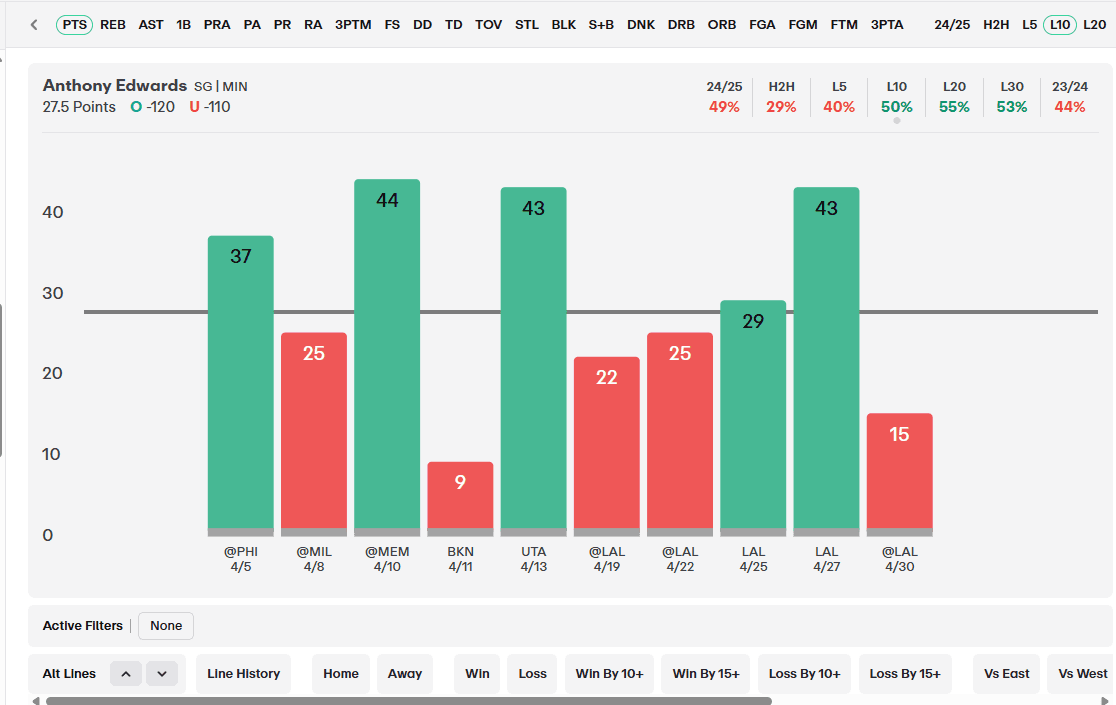
A raw hit rate is the most misread number in prop research. Ten of the last twelve overs means one thing if the line sat at 4.5 the whole time and something very different if the book has already moved to 6.5. Any tool you trust should show the number a prop was hit at, not just the count. Our breakdown of player prop hit rate data goes further on reading those samples without fooling yourself.
Before you act on a hit rate, check four things:
Sample size after the filters are applied, because 9 for 10 across four filters is noise
The line those games were graded at compared to tonight number
Whether the trend is already priced in, which shows up as a shorter price on the over
How recent the underlying games are relative to the current rotation
More Than One Book Price
Props carry heavier vig than sides and totals, often 20 cents or more between the over and the under at a single book. Shopping the same prop across every account you hold is the least glamorous habit in betting and the one with the clearest math behind it.
A 20-Minute Nightly NBA Prop Routine
Volume is the trap in the NBA. Eleven games and 300 players will absorb as much time as you hand them, so the routine needs a hard stop. Mine runs in two passes: a longer one in the afternoon and a short one right before tip.
Afternoon, ten minutes. Open your prop tool, sort the full slate by the largest gaps between projection and posted line, and write down eight to twelve names. No bets yet.
Cut the list. Drop anything where the edge rests on a single filtered sample or on a player whose role is about to change. You should be down to three or four.
About 30 minutes before tip, read the injury report again. This is where the list either survives or gets replaced entirely.
Shop the survivors. Compare the price at every book you hold using line shopping apps before you click anything.
Log the bet with the number you took and the number it closed at. That log is the only honest scoreboard you have.
The second pass is the one people skip, and it is the one that pays. A name that looked like a 15 cent edge at 2pm can be the wrong bet entirely once the starting lineup is confirmed, and it can also become the best number on the board.
If you want the afternoon pass to cost almost nothing, PropFinder runs $14.99 per month with code BETSMART taking 30 percent off the first month, and its free tier covers one game per league. That is enough to see whether the filters match the way you research before you pay for anything.
Example
Example
A useful prop bet log holds six fields: date, player and market, the line and price you took, the book, the closing line and price, and one sentence on why you bet it. After 200 rows you can sort by that last field and see which of your reasons actually beat the close. That finding is worth more than any single night of results.

NBA Prop Tools Worth Paying For
None of these are pick services and none of them remove the judgment call. What they change is how fast you get to the call and how good your price is once you make it. Current monthly rates:
Props.Cash, $19.99 per month, deep prop filters and projections across the major leagues
PropFinder, $14.99 per month, prop research with a proprietary rating system and a free tier
Outlier, from $19.99 per month, prop research alongside a positive EV feed and an arbitrage scanner
Doink Sports, $16.99 per month, prop and game line research with a permanent free plan covering one game per league
Unabated, $199 per month, a professional grade odds screen for bettors who live in the prices
Pikkit, free with a $39.99 paid tier, bet syncing and tracking rather than research
Props.Cash for Nightly NBA Research
Props.Cash is the one I open first on a basketball slate, mostly because of how the filters stack. You can split a player history by pace tier, opponent defensive rating, home and away, and which teammates were active, then read the result against the current line without leaving the screen. On a sport where the context resets every night, that stacking is the feature that matters.
It is a research tool rather than an odds platform, so pair it with something that prices the wider market. Our Props.Cash review covers where it comes up short, and the Outlier vs Props.Cash comparison is the right read if you would rather have one subscription doing both prop research and EV work.
Props.Cash runs a 7-day free trial that opens the full tool, and code BETSMART takes 30 percent off the first month after it. Start the trial through Props.Cash.
Matching the Tool to How You Actually Bet
If you bet three or four props a night, a dedicated research tool plus your sportsbook apps is the whole stack. If you are firing across the slate and want the market scanned for you, Outlier bundles prop research with EV and arbitrage on a 7-day trial with no code required. If your problem is that you have no idea what your props have actually returned, the fix is a tracker like Pikkit, not another research subscription. The wider set of NBA betting tools we have reviewed goes past props into game lines and models.
Example
Example
A useful prop bet log holds six fields: date, player and market, the line and price you took, the book, the closing line and price, and one sentence on why you bet it. After 200 rows you can sort by that last field and see which of your reasons actually beat the close. That finding is worth more than any single night of results.

Where NBA Prop Bettors Leak Money
Most losing prop seasons are not caused by bad reads on players. They are caused by four repeatable mistakes, all of which live upstream of the bet itself.
Back-to-Backs and Rest Management
The second night of a back-to-back is where minutes projections go to die, especially for veterans and anyone recently back from injury. A player on a soft cap can log 26 minutes in a game you modeled at 34, and no filter rescues a bet built on the wrong denominator. Check the rest situation for both teams before you check anything else.
Blowout Risk
Overs need fourth quarters. A prop that requires a starter to play his usual 35 minutes is live in a projected three point game and close to a coin flip in one the market expects to be settled by the middle of the third. Large spreads should push you toward unders and toward players whose production comes early, not toward a star scoring line at a shorter price.
Chasing a Streak the Market Already Priced
By the time a player has cleared his points line six straight games, the book has moved the number and shaded the price. The trend is real and the value is gone. The better use of that observation is the game after the streak breaks, when the line drifts back down and the underlying role has not changed.
Stacking Props Into Parlays
Prop parlays compound vig faster than they compound edge, and books price the obvious correlations before you get there. If you are going to build them, build them on purpose. Our guide to player prop parlays covers where correlation genuinely helps and where it just costs you.
Final Word: Bet NBA Props Like a Pro
NBA props reward the boring parts. Knowing who is out, knowing what pace does to the ceiling, reading a hit rate with the line attached, and taking the best available price. None of it is glamorous, and all of it compounds across a season that puts a slate in front of you almost every night.
A subscription does not make the read for you. It shortens the distance between roster news and a placed bet, which on a sport this fast is most of the job. If you want to test that, Props.Cash runs a 7-day free trial and code BETSMART takes 30 percent off your first month.
NBA Player Prop Tool FAQ

Additional Resources
Explore our curated selection of guides and tools to help promote responsible gambling.

Rugby Betting Guide: Union, League, Markets and Key Margins
How rugby union and league price differently, the markets worth betting, the 2026 calendar, and the tools that actually cover rugby.

Esports Betting Guide: Markets, Formats, and Finding Value
A practical esports betting guide covering markets, series formats, patches, line shopping, and the integrity and legal checks to run before you bet.

Regression Betting Explained: How to Stop Paying for Luck
How regression to the mean creates betting value, which stats in each sport snap back, and how to bet it without overreacting to streaks.

Betting Model Building Explained: From Raw Data to a Fair Price
Build a betting model that prices bets, test it against the market, and size what it finds.