Arbitrage Sports Betting: How to Profit With No Risk
Learn how arbitrage sports betting works, how to find risk-free opportunities, and what tools can help you bet both sides of a game with profit.
By
Eric Pauly
9 min read
What Is Arbitrage Sports Betting?
Arbitrage sports betting is placing bets on every outcome of the same event at different sportsbooks, at prices that lock in a profit no matter which side wins. Bettors call it arbing. It is legal, it is math rather than handicapping, and sportsbooks tolerate it right up until they notice you doing it.
Say DraftKings prices the Chiefs at +112 and Fanatics prices the Bills at -102 on the same game. Those two numbers cannot both be right. Stake the correct amount on each and you collect roughly the same return whether Kansas City or Buffalo wins. Understanding that is the easy part. The work is finding those gaps before they close and staying welcome at enough books to keep using them. This guide covers the math, where the gaps live in 2026, the arbitrage betting tools that surface them, and the risks hiding behind the phrase risk-free.
article Summary
Arbitrage betting covers every outcome across multiple books when their prices disagree, which locks in a return of roughly 1 to 3 percent per position. The math is settled before kickoff. The difficulty is execution: a rejected leg, a stale line, or a limited account turns a closed position into an open bet you never wanted.
How Does Arbitrage Betting Work?
Every posted price carries an implied probability. Add both sides of a two-way market at a single sportsbook and the total lands above 100 percent. That overage is the vig, and it is why betting both sides at one book bleeds money over time. Arbitrage exists when you assemble the two sides from different books and the total falls under 100 percent instead.
Converting Odds Into Implied Probability
For plus odds, divide 100 by the odds plus 100. For minus odds, divide the odds by the odds plus 100, ignoring the sign. The Chiefs at +112 imply 47.2 percent. The Bills at -102 imply 50.5 percent. Together that is 97.7 percent, leaving about 2.3 percent of edge to split between your two stakes. Anything under 100 is an arb, and the further under, the larger the return. A no-vig odds calculator runs the same conversion when you want to see a fair line with the book margin stripped out.
The numbers you will convert most often:
-300 is about 75 percent
-200 is about 66.7 percent
-110 is about 52.4 percent
+100 is exactly 50 percent
+150 is exactly 40 percent
+300 is exactly 25 percent
Sizing Each Side So Both Results Pay
Spotting the gap is half the job. Staking is the other half. Each side takes a share of your total stake proportional to its implied probability, so both tickets return the same amount. Get the split wrong and you have not built an arb, you have built two bets with a hidden preference for one result. This is where an arb calculator earns its place in the workflow, and most scanners now handle the division the moment you enter a total stake.
Why This Falls Apart By Hand
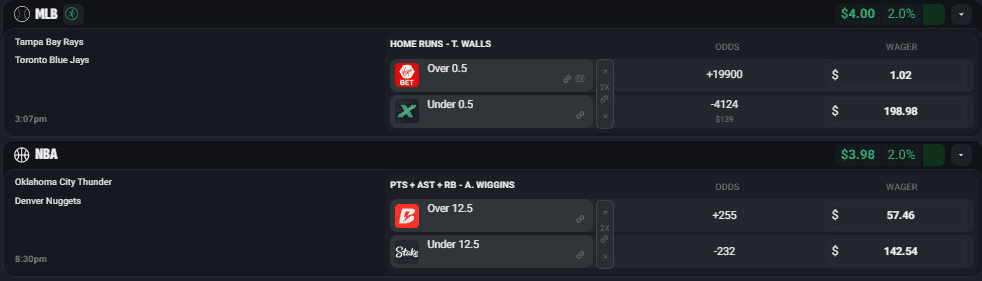
By the time you have four tabs open, the odds converted, and the split worked out, the price is usually gone. When I run a full NFL Sunday through an arb scanner, almost nothing that clears 2 percent is on a main side. It sits in second-half totals, alternate lines, and player props, and it lives for seconds rather than minutes.
Example
Example: Sizing a 2.3 Percent Arb
Total stake $500. Chiefs +112 at DraftKings, Bills -102 at Fanatics.
Chiefs side: $241.50, returning about $512 if Kansas City wins
Bills side: $258.50, returning about $512 if Buffalo wins
Either result pays back roughly $512 on $500 risked, so the position clears about $12 for a 2.4 percent return. That is what a healthy arb looks like. Anyone promising 20 percent per position is describing a market that no longer exists, or a bet that will get voided.
Why Arbitrage Still Works in 2026
The usual assumption is that the books closed these gaps years ago. They did tighten the headline markets. What also happened is that the board got far wider at the same time, so the gaps moved to its edges rather than disappearing.
More Books Means More Disagreement
Every additional sportsbook, exchange, and prediction market is another opinion on the same event, and disagreement is the raw material for arbitrage. A regional book with a small trading desk cannot reprice 40 in-game props as fast as a market leader can. Watching hold percentages across books week to week, the two-way NFL sides usually sit within a cent or two of each other. The daylight is in the markets nobody is watching closely.
Exchanges and Prediction Markets Widened the Board
Peer-to-peer platforms price differently than traditional books because users set the numbers instead of a trading desk. That produces legs a sportsbook would never post at the same price. Novig runs as an exchange rather than a book, and code BETSMART adds a 100 percent purchase match up to $25. Prediction markets such as Kalshi put another set of prices on overlapping outcomes, which is where a growing share of cross-platform arbs now sit.
Where the Gaps Actually Live
Player props, quarter and second-half totals, alternate lines, and lower-profile leagues produce more arbs than marquee markets, because fewer eyes are on them and limits are lower for exactly that reason. Live betting is the other reliable source. A book that is slow to reprice after a 12 to 0 run leaves a number on the board that no longer matches the game. That is a harder execution problem, and it is worth seeing what live arbitrage betting demands before trying it with real money.
Tools That Find Arbitrage Bets Before They Close
Nobody finds arbs by refreshing tabs. Serious arb bettors run a scanner that watches every book at once, flags the gaps, and hands over the stake split. What separates the tools is refresh speed, book coverage, and whether they handle live markets or stop at pre-game.
What an Arb Scanner Actually Does
Four jobs: pull prices from every book on a short refresh cycle, compare both sides of each market, size each leg against your bankroll, and get you to two bet slips quickly. A tool that fails the fourth job is a research product, not an arb product. Every scanner I have tested surfaces some opportunities that are already dead by the time you click through, so judge them on how often the flagged price is still standing, not on how many alerts they fire.
Bookie Beats for Live and Pre-Game Arbs
Bookie Beats is built around live and pre-game EV and arbitrage rather than a general odds screen, and it ships with a low hold finder and bet calculators for stake sizing. At $400 per month it is priced for bettors already turning volume into profit, and code BETSMART takes $50 off the first month. It also integrates with Novig and ProphetX, which matters when your best leg is on an exchange. Our Bookie Beats review covers the tradeoffs, including the lack of a real-time odds screen.
Outlier for a Cheaper Entry Point
Outlier starts at $19.99 per month and bundles arbitrage with positive EV, devigging, and prop research. It is the more sensible place to start if you are still testing whether arbing fits your bankroll and the books you can actually access. The tradeoff is thinner historical data than the higher-priced platforms carry.
OddsJam for Coverage and Tracking
OddsJam sits at $199.99 per month and pairs its arb and EV screens with bet and closing line tracking, which is useful when you want a record of what you actually got filled at rather than what was advertised. It is a lot of platform for someone placing a handful of arbs a week, and the price reflects that.
Example
Example: A Two-Way Tennis Market
US Open fourth round, Coco Gauff vs. Iga Swiatek.
DraftKings: Gauff +110
FanDuel: Swiatek +105
Two-way market, no draw, both sides plus money. A $400 bankroll splits into about $198 and $202 and returns roughly $415 either way, which is close to $15 of profit. The scanner flags it, sizes it, and opens both slips. The leg you place second is always the one at risk, so put your money on the thinner market first.

The Risks Inside a Risk-Free Bet
A completed, correctly sized arbitrage position cannot lose. That is a real property of the math. Almost everything that goes wrong happens before the position is complete, or after it has been graded.
One Leg Fills and the Other Does Not
This is the most common failure. You get down on the first side, the second book has already moved or refuses your stake, and now you hold a straight bet you never wanted at a price you would not have chosen. A hedge calculator tells you what closing the position at the new number costs, and the answer is often to take a small certain loss instead of letting it run.
Limits That Do Not Match Your Stakes
An arb is only as big as the smaller of the two maximum bets. Thin markets, which is where most arbs live, carry the lowest limits. A 4 percent edge on a $50 maximum is $2, and $2 does not pay for a subscription.
Voids, Rule Differences, and Palpable Errors
If one book voids a leg for a scratched pitcher while the other graded it as action, your cover disappears and you are exposed on a bet you never intended to hold. Books also differ on whether overtime counts toward a total, on how they settle a player who takes zero snaps, and on what qualifies as a palpable error they can cancel after the fact. Read the house rules for the markets you arb before you need them.
Getting Limited
Sportsbooks lose money on arb bettors and they are good at identifying them. Odd stake sizes at outlier prices, bets placed seconds after a line move, and volume that only ever lands on the off number are the patterns that trigger a review. Restrictions arrive quietly. Your maximum drops from $2,000 to $28 and no email explains why.
How to Arb Without Burning Your Accounts
Account longevity is worth more than any single position. A bettor who clears 2 percent for two years beats one who clears 4 percent for six weeks and then gets cut to $25 maximums everywhere. My own process is built around looking ordinary at every book I care about keeping.
Round stakes to numbers a recreational bettor would use. $50, not $47.83.
Mix in normal action at the books you want to keep, including favorites at the standard price and the occasional parlay.
Skip the smallest arbs. A 0.6 percent position is not worth the attention it draws.
Spread volume across accounts instead of hammering the one book with the softest prices.
Keep deposits and withdrawals unremarkable. Pulling money out minutes after every win reads as professional.
Track every fill. You cannot tell which book is tightening on you if you never recorded what you got.
Bankroll works differently here too. Capital sits idle across many accounts, so $5,000 spread over eight books is really eight small bankrolls, and the return on the whole pile looks modest next to the effort. That is the honest tradeoff. The same habit that makes arbing possible, checking every book before you place anything, is also the habit behind finding the best odds on the bets you were making anyway.
Final Thoughts
Arbitrage is one of the few approaches in betting where the math is settled before the game starts. What is never settled is execution: whether both legs fill, whether the limits are large enough to matter, and how long the books let you keep going. Treat it as an operations problem rather than a handicapping problem and the returns are real, if unglamorous.
The same structure shows up in prediction markets, where price gaps between platforms like Kalshi and Polymarket let you cover both sides of an outcome for a profit. MarketMath compares prediction market odds across platforms, which makes those cross-platform gaps easier to spot.
Arbitrage Sports Betting FAQ

Additional Resources
Explore our curated selection of guides and tools to help promote responsible gambling.

MLB Strikeout Props: How to Research and Price K Lines
Build a strikeout projection from batters faced and matchup K rate, then price it against the line before you bet.

NFL Rushing Props: How to Bet Carries, Game Script, and Price
Rushing props are a workload market. Here is how to project carries, read game script, and price the number before you bet it.

NFL Passing Yards Props: How to Build Your Own Number
Price NFL passing yards props from attempts, yards per attempt, and game script, then shop the quarterback line across books.

NFL Touchdown Props: A Guide to Pricing, Value, and Research
Anytime, first, and 2+ touchdown props are three different bets wearing the same jersey. Here is how each one is priced and where the value hides.